

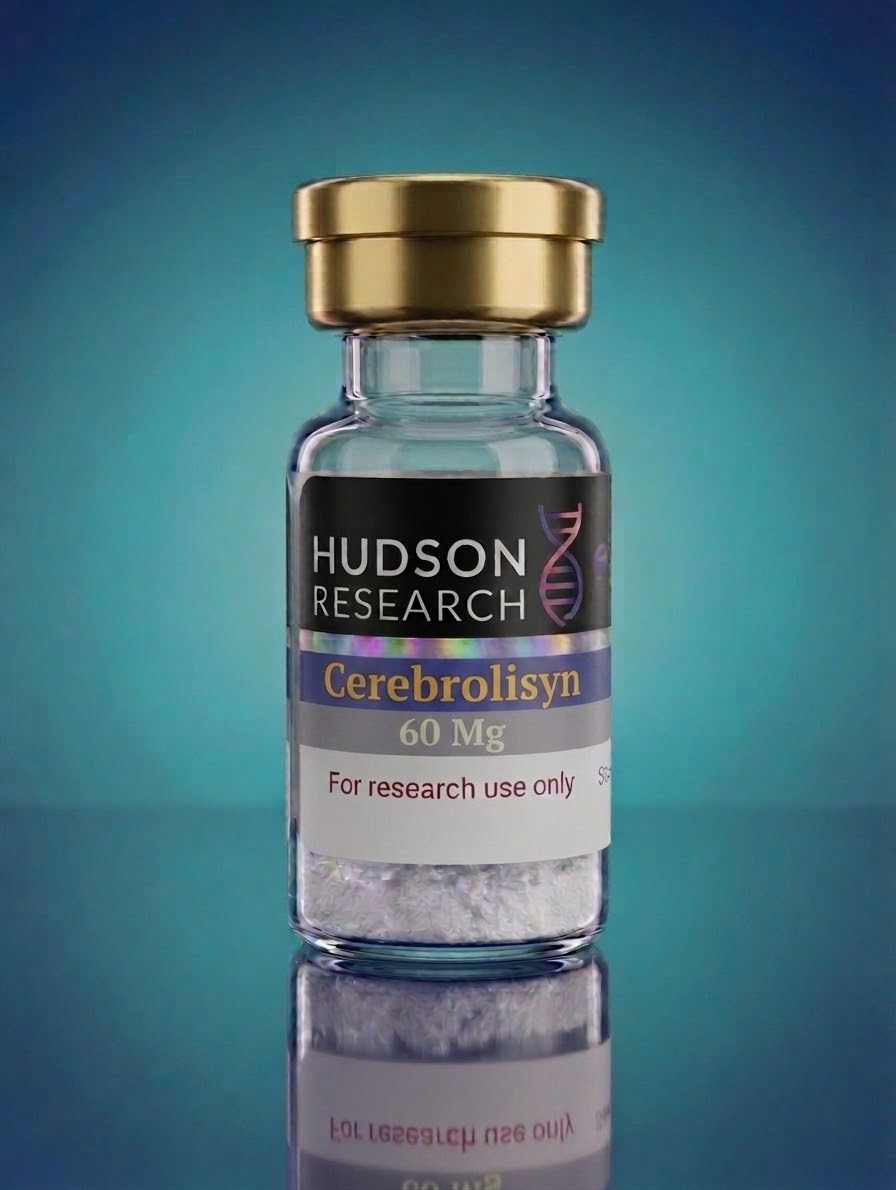


Cerebrolysin: Research Overview, Scientific Background, and U.S. Regulatory Information
Product Overview: Understanding Cerebrolysin
Cerebrolysin is a specialized neuropeptide preparation studied for its potential role in neurological recovery and brain-related conditions. Unlike a single, chemically defined peptide, Cerebrolysin is a complex mixture of low-molecular-weight peptides and amino acids derived from porcine brain proteins. Its composition makes it distinct from synthetic research peptides that contain one defined amino acid sequence.
Interest in Cerebrolysin has grown among researchers, healthcare professionals, and people seeking reliable information about emerging approaches to neurological research. However, understanding its composition, clinical evidence, regulatory status, and safety considerations is essential before drawing conclusions about its potential applications.
For readers researching Hudson research lab peptides, this guide provides an educational overview of Cerebrolysin, explains important scientific distinctions, and outlines what U.S. consumers and research professionals should know when evaluating peptide-related information online.
What Is Cerebrolysin?
Cerebrolysin is a peptide-containing preparation manufactured through the enzymatic breakdown of purified porcine brain proteins. The resulting mixture contains short peptides and free amino acids rather than one isolated active peptide.
Scientific interest in this preparation centers on its proposed effects on neurological processes. Researchers have investigated its potential relevance to recovery following stroke, traumatic brain injury, and certain forms of cognitive impairment.
These research areas are important, but preliminary findings should not be confused with proof of effectiveness for every condition or population. Clinical outcomes depend on the specific condition being studied, the quality of the evidence, and the treatment protocol evaluated.
Cerebrolysin is also different from conventional dietary supplements and general wellness products. Its injectable pharmaceutical formulation requires particular attention to manufacturing quality, sterility, product identity, and appropriate medical oversight.
Cerebrolysin and Neurological Research
Investigating Neurorecovery
One area of scientific interest is neurorecovery, the process through which the nervous system responds to injury and rehabilitation. Researchers have investigated whether Cerebrolysin may influence biological processes associated with neuronal function and recovery.
Research involving stroke rehabilitation and traumatic brain injury has explored several clinical outcomes, including functional recovery and neurological impairment. However, the results across studies are not uniformly positive, and the evidence must be interpreted according to each study’s design and limitations.
A systematic review of clinical trials is particularly valuable because it evaluates findings across multiple studies rather than relying on a single favorable result.
Cognitive Research and Brain Function
Cerebrolysin has also been investigated in studies involving cognitive impairment and dementia. These studies explore whether the preparation may have a role in particular clinical settings.
It is important to distinguish investigation from established treatment. Research involving individuals with a diagnosed neurological condition does not demonstrate that Cerebrolysin improves memory, concentration, or mental performance in healthy individuals.
For anyone exploring neurological research, scientifically responsible information should clearly separate established findings, uncertain evidence, and claims that have not been adequately demonstrated.
What Does the Scientific Evidence Show?
The clinical literature on Cerebrolysin contains both positive findings and important limitations.
Some studies have reported improvements in selected measures of neurological recovery. Other research has not demonstrated a clear benefit on primary clinical outcomes. A 2023 Cochrane review examining Cerebrolysin for acute ischemic stroke concluded that the available evidence did not establish a reduction in all-cause mortality and identified concerns about serious nonfatal adverse events.
These findings illustrate why comprehensive scientific evaluation matters.
When reviewing Cerebrolysin research, consider the following factors:
- Study design: Randomized controlled trials generally provide stronger evidence than uncontrolled observations.
- Clinical outcomes: Changes in a measurement do not necessarily translate into meaningful improvements in daily functioning.
- Participant characteristics: Results in people recovering from a stroke cannot automatically be applied to healthy adults.
- Safety findings: Potential adverse events should be assessed alongside any reported benefits.
- Reproducibility: Findings should be evaluated across multiple independent studies.
An evidence-based approach avoids exaggerated promises and helps readers understand the difference between a promising research question and a clinically established conclusion.
U.S. Regulatory Status of Cerebrolysin
The regulatory status of a product is a crucial consideration for anyone researching peptide-related substances in the United States.
According to the official Cerebrolysin website, Cerebrolysin is not registered with the U.S. Food and Drug Administration (FDA) and is not approved for sale or distribution in the United States. Its availability and approved uses differ in certain other countries.
FDA maintains a substance identifier for Cerebrolysin, but the existence of an identifier does not mean that a finished drug product has been approved.
Readers should not assume that a product advertised online is FDA-approved simply because a seller describes it as pharmaceutical grade, laboratory tested, or research quality.
For authoritative information, consult the official Cerebrolysin website and the FDA drug approval resources.
Because regulatory requirements can change, check current official sources before making decisions concerning a specific product.
Evaluating Hudson Research Lab Peptides
People searching for Hudson research lab peptides may encounter online product listings, scientific descriptions, and statements about laboratory quality. Evaluating these claims carefully is an important part of responsible research.
Before relying on any supplier’s information, consider the following questions:
1. Is the supplier’s identity verifiable?
Look for a clearly identified business, verifiable contact information, transparent policies, and accurate descriptions of its activities. A website’s existence alone does not establish that it is an authorized pharmaceutical distributor.
2. Is product identity documented?
Product documentation should accurately identify the material being described. For a complex biological preparation such as Cerebrolysin, a generic peptide certificate or an unrelated laboratory report cannot independently establish equivalence to the registered pharmaceutical product.
3. Are quality claims independently supported?
Statements about purity, sterility, potency, and manufacturing standards should be supported by appropriate documentation. A certificate of analysis is only as useful as its methods, results, traceability, and relationship to the specific batch.
4. Are regulatory claims accurate?
Descriptions such as “FDA registered,” “FDA approved,” and “laboratory tested” refer to different things. They should never be used interchangeably.
5. Is the intended use clearly stated?
Research materials and approved medicines are not interchangeable categories. Research labeling does not establish that a product is suitable for human administration.
These checks provide a more reliable foundation for evaluating peptide-related websites than promotional claims alone.
Safety Considerations and Responsible Information
Cerebrolysin is an injectable preparation, not an ordinary nutritional supplement. Its use involves considerations that extend beyond those associated with typical consumer wellness products.
Potential adverse reactions reported in product information include headache, dizziness, sweating, and nausea. Product information also identifies contraindications and precautions that require professional assessment.
Unverified injectable products may present additional risks associated with contamination, incorrect composition, inadequate sterility, or uncertain storage conditions.
Do not assume that a product sold online is safe for injection, suitable for personal use, or equivalent to a regulated pharmaceutical preparation. Do not use research-labeled materials for self-treatment.
Anyone considering treatment for a neurological condition should consult a qualified healthcare professional about evidence-based options and the risks and benefits of available treatments.
Frequently Asked Questions About Cerebrolysin
Is Cerebrolysin FDA-approved in the United States?
No. The official Cerebrolysin website states that the preparation is not FDA-approved and is not approved for sale or distribution in the United States.
Is Cerebrolysin a single peptide?
No. Cerebrolysin is a complex mixture of short peptides and amino acids derived from porcine brain proteins.
Does Cerebrolysin improve memory or concentration?
Current evidence does not establish that Cerebrolysin improves memory or concentration in healthy individuals. Findings from studies involving neurological conditions should not be generalized to healthy populations.
How can readers evaluate Hudson research lab peptides?
Review supplier identity, product documentation, independent quality evidence, regulatory statements, and intended-use information. Do not interpret a seller’s claims as proof of FDA approval or pharmaceutical equivalence.
Where can readers find reliable Cerebrolysin information?
Start with official product information, published clinical research, systematic reviews, and U.S. regulatory resources. Consult a qualified healthcare professional for individual medical questions.
Conclusion: Make Evidence-Based Decisions
Cerebrolysin remains a subject of scientific interest in neurological research, but its clinical evidence, safety considerations, and regulatory status must be understood before drawing conclusions about its applications.
For individuals researching Hudson research lab peptides, prioritizing transparent documentation and credible scientific sources is a more reliable strategy than depending on unverified marketing statements. Accurate information, careful evaluation, and appropriate professional guidance are essential when researching injectable biological preparations.
The most responsible approach is to distinguish scientific investigation from established medical treatment and to verify regulatory claims through official sources before making decisions.
| qty | 1 VIAL, 2 VIALS, 3VIALS, 5 VIALS, 10 VIALS |
|---|
Be the first to review “Cerebrolisyn”
Related products
HUDSON LAB
HUDSON LAB
HUDSON LAB
HUDSON LAB
HUDSON LAB
HUDSON LAB
HUDSON LAB
HUDSON LAB
Reviews
There are no reviews yet.